
Did you miss the September Forum on scams? See the review included here – or come to the “Scams and how to avoid being caught” session on Monday 2 October 2-4 pm (see details at the bottom of this article). The October Forum sounds inspiring – read about it below.
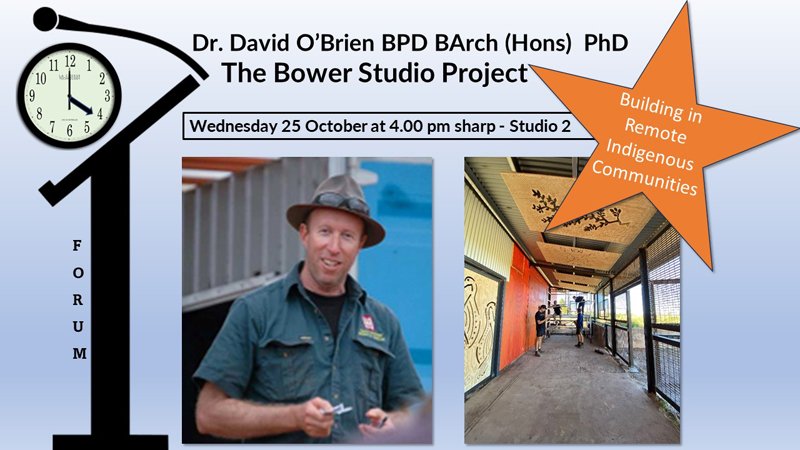
Dr David O’Brien, Director of Melbourne University’s Bower Studio Program
Wednesday 25 October, Studio 2 at 4 pm
By June MacDonald, Four O’clock Forums Co-ordinator
October’s Four O’clock Forum will be an insightful exposé for our time. I had never heard of the Bower Studios or the Bower Project before a tip came from one of our members. I know you will enjoy listening to Associate Professor Dr David O’Brien BPD, BArch (Hons), PhD as much as I did. I am delighted he could find time to talk to you about his work. He is a senior lecturer in Architectural Design and Technology, but he is not some dry academic. Dr O’Brien is a man for all seasons. He is engaging and passionate and he initiated the Bower Studio in 2007.
The Bower Studios are a sequence of Master of Architecture design projects at The University of Melbourne’s School of Design.
Unveiling the success of the Bower Studio
The multi-award-winning Bower Studio links Indigenous community groups with postgraduate architecture students and staff from the University of Melbourne. Responding to each community’s call for specific infrastructure projects. Staff and students collaborate in the design and construction phases and respond to both short and long-term goals.
They only work in communities when invited by the leaders and when the community contributes a local workforce. This builds stronger relationships, more meaningful outcomes and ensures that all participants experience the project as a partnership. This also ensures that the architecture students return to Melbourne with stronger and more relevant capacities to suggest future community improvements.
Guest speaker shares his insights
Dr O’Brien has managed construction projects in remote communities in Western Australia, the Northern Territory, Queensland, Torres Strait, Papua New Guinea, and Thailand. He will be talking about building community relationships, drawing on diverse and complementary skills, managing advocacy and policy development, and negotiations focused on Indigenous communities. He has a good story to tell.
Report on the August Forum – Cybersecurity, hacks & scams
By Helen Smith, Computer Class Leader
We’re all keen to protect ourselves from scams. Dianne Bunney, from P1 Technology, made us aware of the key characteristics of scams. The scammers often try to:
- Gain our trust –by claiming to represent a company we recognise or by impersonating family or friends
- Make us panic by emphasising the urgency to take action so that we don’t stop and think
- Avoid meeting in person or on video calls and make excuses about why.
A number of examples of scams were discussed, including some raised by the audience.
Tips to avoid falling for a scam
We were reminded that to avoid getting caught:
- If in doubt, don’t click.
- Go to official websites and fact-check.
- Never give out usernames and passwords.
- Call your friends and family on the phone numbers you have for them to verify any SMS claiming to be from them.
- Keep your devices’ operating system up-to-date and ensure you are running anti-virus software.
- Only do sensitive transactions such as banking using trusted Wi-Fi such as your home.
- Don’t allow anyone access to your computer unless you know and trust them.
Dianne finished with the excellent advice:
STOP – THINK – CHECK before you ACT
Missed the session? Have more questions?
Sign up for the new session ‘23COM411 Scams and how to avoid being caught‘ on Monday 2 October, 2 pm to 4 pm in Studio 9.
We’ll look at more scam examples, review the steps to keeping safe and discuss what to do if you’re unlucky enough to get caught.
<- Previous
Next ->