
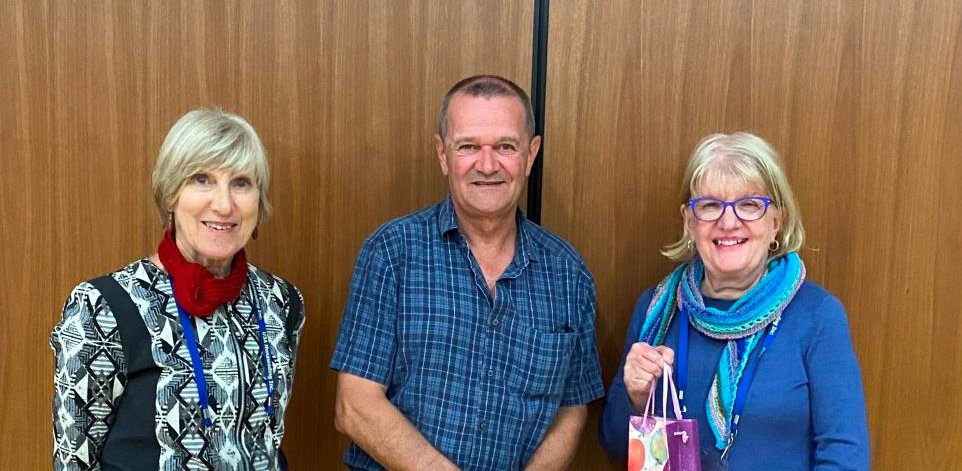
Guest speaker Mark Balla with U3A Nunawading President Liz Hooper (left) and Athalie Edis, who gave the vote of thanks.
By Brian Ruck
The April Forum was one of the most eye-opening, thought-provoking and inspiring talks I’ve heard in a long while. Guest speaker, Mark Balla, related stories of his experiences on a business trip to India a few years ago where schools often don’t have toilets.
No toilets, no school
Mark visited a school and noticed that whilst there were many primary-aged children of both sexes and older boys, there were no teenage girls. He asked why and was told “because there are no toilets”. It was as simple as that. That meant that every month, the students missed a couple of days of school and one of their parents missed a couple of days work because they had to look after them.
He also discovered that the only teacher, a young woman, could not work during her periods because of the absence of any suitable toilet facilities. The teacher lost her dignity because everyone in the village knew when she was having her period. When she did work, she didn’t drink through the day because of the fear of needing to go to the toilet.
Becoming a toilet warrior
Mark, like any other reasonable person, was appalled by this situation. But unlike many, he was not satisfied to just be appalled, he had to do something. He and a local business colleague immediately put their hands into their pockets and each chipped in about $400 to get the estimated $800 necessary to build a suitable toilet.
And it didn’t stop there! With the assistance of the International Rotary Organisation, he became a “Toilet Warrior” and a member of the WTO. Not the World Trade Organisation, but the World Toilet Organisation. It now has a number of toilet projects, not only in India, but in many developing countries around the world. They have found that by simply providing toilets in schools, they have improved the participation and retention rate of girls which is a huge step forward in the lives of hundreds, maybe thousands, of girls.
Cultural challenges
It has not been easy. Mark explained that they could not help many schools because of cultural problems. There were many schools where the school governance systems were unprepared to ensure the on-going maintenance and usability of a new toilet block. So, rather than waste valuable donated money building toilets that wouldn’t be maintained, Mark and his other warriors had the heartbreaking task of walking away from thousands of children in need.
Wherever possible, local workers and materials were used for the projects and the choice of the facilities such as squats or western pedestal was left to the individual schools. As Mark said, it was not their job to change India, rather it was to just to facilitate the provision of suitable toilets.
Mark illustrated his talk with some confronting photos of the non-existing facilities, interspersed with inspirational photos and statistics of some of the successful projects. His work is continuing and he has written an interesting book of which proceeds from the sale go to the toilet projects
Assistance has expanded into land restoration
Following the toilet talk, Mark gave us a peek at a new, successful project in land restoration. A friend in India lost his teenage daughter to a drinking water-borne disease. As part of his grief management, he went out and planted 111 trees in the wasteland around his village. Then, on the daughter’s next birthday, he planted another 111 trees. Other villagers followed his example and started planting trees to mark births of daughters and their special occasions etc. To date, they have planted about 350,000 trees.
They also found that termites were getting into the trees, but aloe vera plants kept the termites at bay. So, they started planting aloe vera as companion plants and are now harvesting the aloe vera and making soap and similar products. Not only is this creating jobs, but the profits from the project are being put into trust accounts in the name of every girl in the village to be made available to them when they reach the age of 18.
As I said at the start, a truly inspiring talk.