

By Yvonne Desousa, Class Leader
On the last day of Term 2, the level 6 Japanese Class were treated to a rare delight. Paul Maguire welcomed us to his beautiful home where he hosted a Tea ceremony.
The history of a Tea Ceremony
Until the end of the Edo period tea was for the wealthy, nobles, some Samurai and monks. After 1868, wealthy merchants also performed the tea ceremony.
Powdered green tea was used as a medicine.
The flowers in the Tea Ceremony room should be natural, just as if the flower was simply cut from the garden and put into a suitable vase, with no smell (as this will interfere with the smell of the tea), and there should be no thorns.
Carefully choosing the equipment and environment
The selection of the equipment is carefully chosen to reflect the season, the style of Tea ceremony being performed, who the guests are and their interests (the host must ensure that the guests feel comfortable).
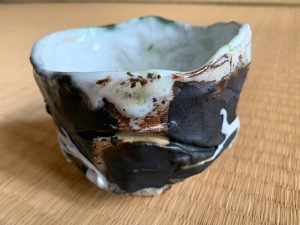
The Tea Ceremony room has tatami mats on the floor. The mats are made from reeds, straw or rush grass and were seen as a luxury in ancient Japan.
The cracks and fading colours on the Tea Ceremony bowls are considered beautiful in Japan. Japanese people think imperfections make things more aesthetically pleasing (wabi sabi) that goes along with the minimalistic Japanese philosophy.
Promoting equality
Older tea houses have a ‘half height’ door. This has ties to the Samurai Era when the warriors had to take off their weapons and armour before entering the tea house. This was to promote equality between the guests and the belief that ‘all people are equal in the way of the tea’.
There are just so many rules for the Tea Ceremony and the training usually takes years.
See more of the Tea Ceremony in pictures