

The mooncake cooking demonstration presented by Lan Tiet was a great success, with 34 eager participants. Lan had some beautiful hand-crafted mooncakes prepared beforehand and showed the group how these are made. She encouraged a couple of participants to come up and learn (hands on) as she made them.
Many questions came from the attendees regarding quantities and method of preparing and cooking the cakes. Some of the flavours were matcha, black sesame seed, and fruit and nut. At tasting time, the matcha and fruit and nut ones were very popular.
There were also many different mooncake styles for sale during and after the session. See the Mooncake cooking demonstration Photo Gallery
Proceeds donated to charity
Over $1,000 was raised for Niemann-Pick disease type C (NPC) charity. NPC is a rare progressive genetic disorder characterized by an inability of the body to transport cholesterol and other fatty substances (lipids) inside of cells.
A good time was had by all. Special thanks to Lan Tiet for this session.
About mooncakes
Mooncakes, a rich pastry typically filled with sweet-bean or lotus-seed paste, are traditionally eaten during the Mid-Autumn Festival and are regarded as a delicacy. The festival is primarily about the harvest while the legend of Chang’e, the Moon goddess in Chinese mythology, connects it to moon watching.
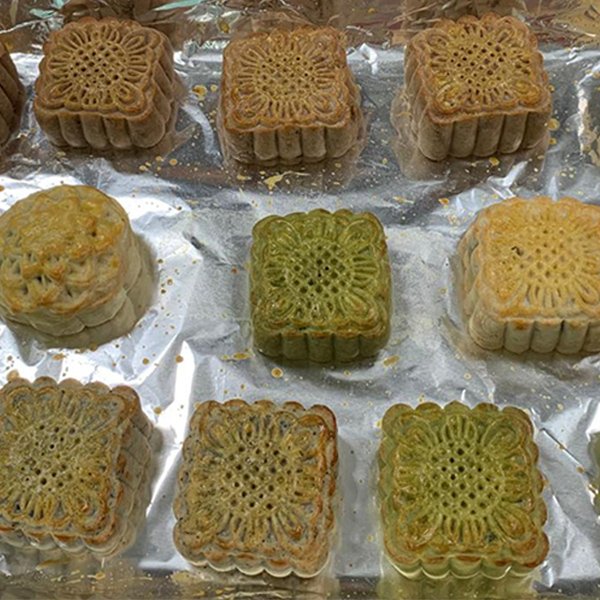
The Cantonese mooncake is the most famous variety. A traditional Cantonese mooncake is a round pastry, measuring about 10 cm in diameter and 3–4 cm thick, with a rich, thick filling usually made from lotus seed paste (other typical fillings include red bean paste or mixed nuts) surrounded by a thin, 2–3 mm crust and may contain yolks from salted duck eggs.
The Mid-Autumn Festival is held on the 15th day of the 8th month of the Chinese lunisolar calendar with a full moon at night, corresponding to mid-September to early October of the Gregorian calendar. On this day, the Chinese believe that the moon is at its fullest and brightest, coinciding with the time of harvest in the middle of autumn.
During the festival, lanterns of all sizes and shapes – symbolising beacons that light the path toward prosperity and good fortune for the people – are carried and displayed.
The Mid-Autumn Festival is one of the most important holidays and celebrations in Chinese culture; its popularity is on par with that of Chinese New Year.
(adapted from Wikipedia)